Halma

Game preview: Halma

MOVES0
GOAL0/10
TURNYOU

Halma

Game menu

Settings

Choose each player

Sound

Halma

Interactive demo

How to play

Moving pieces

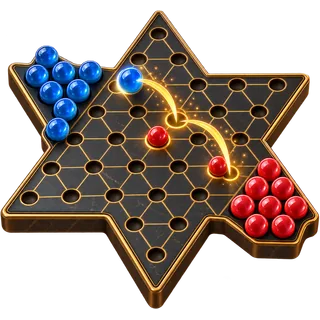
Select your own piece and then a marked empty destination. Step to a neighbouring point. The star lattice has six directions.

Building jump chains

Jump over an adjacent piece of either colour onto the empty point beyond it. Several jumps can form one move. Jumped pieces stay on the board.

Filling the target camp

Bring every piece into the opposite camp. A piece that has arrived may move within that camp but cannot leave it again. The first side to bring all pieces home wins. In new matches, a piece permanently sealed in its starting camp makes the match a draw. A temporary blockage does not end the match.

Choosing board and opponent

Choose two to six occupied seats. Set each colour to a person on this device, computer or not occupied. Empty camps remain free; all 121 points on the standard board stay playable. Larger stars offer 181 or 253 points. Choose the starting colour in Settings. With two players, the computer starts by default. The turn order continues around the board from that colour.

Pausing and saved games

Your registered account can keep an ongoing Halma game in one of three slots shared across games, ready for more jump chains later.

Restart this match?

MATCH COMPLETE

Leave game?

Do you really want to leave the game and return to the home page?

About the game

Game idea

Halma is a race across a shared board. Move your pieces from their starting camp into the opposite corner without capturing opposing pieces.

What matters

Occupied points are both obstacles and stepping stones. A useful formation opens long jump chains without leaving stragglers behind in the home camp.

This version

Several board sizes, computer strengths and a local two-player mode are available. Unlike a dice race, every advance comes from your move planning.

Halma: how to play and options

Goal and key rules

Bring every piece into the opposite camp. Step to a neighbouring cell or jump over any adjacent piece into the empty cell beyond. Several jumps can form one move; no pieces are captured. New matches end in a draw if a piece is permanently sealed inside its starting camp; a temporary blockage does not end play.

Controls

Select your own piece and a marked destination. Arrived pieces may rearrange inside the target camp but cannot leave it. Against another person, take turns on the same device.

Playing tips

Build jumping chains rather than racing just one piece ahead. Both friendly and opposing pieces can form bridges. Move your rearmost pieces out early so they do not remain stranded.

Settings and variants

The player count initially fills suitable seats. Assign each colour individually to a person, computer or not occupied. At least two seats must be occupied. Computer strength applies to every computer.

  • Number of players: 2, 3, 4, 5, 6.
  • Blue: Not occupied, Person on this device, Computer.
  • Amber: Not occupied, Person on this device, Computer.
  • Emerald: Not occupied, Person on this device, Computer.
  • Gold: Not occupied, Person on this device, Computer.
  • Violet: Not occupied, Person on this device, Computer.
  • Coral: Not occupied, Person on this device, Computer.
  • Board size: 121 points · 10 pieces per player, 181 points · 15 pieces per player, 253 points · 21 pieces per player.
  • Difficulty: Easy, Medium, Hard.

Display and sound

The timer display can be shown or hidden. Reduced motion limits effects while keeping necessary game movement visible. Sound can be switched on or off independently.

On a new page visit, Start game begins a fresh round using your saved preferences. An abandoned round does not resume automatically. Game information explains further scoring details and available assists.